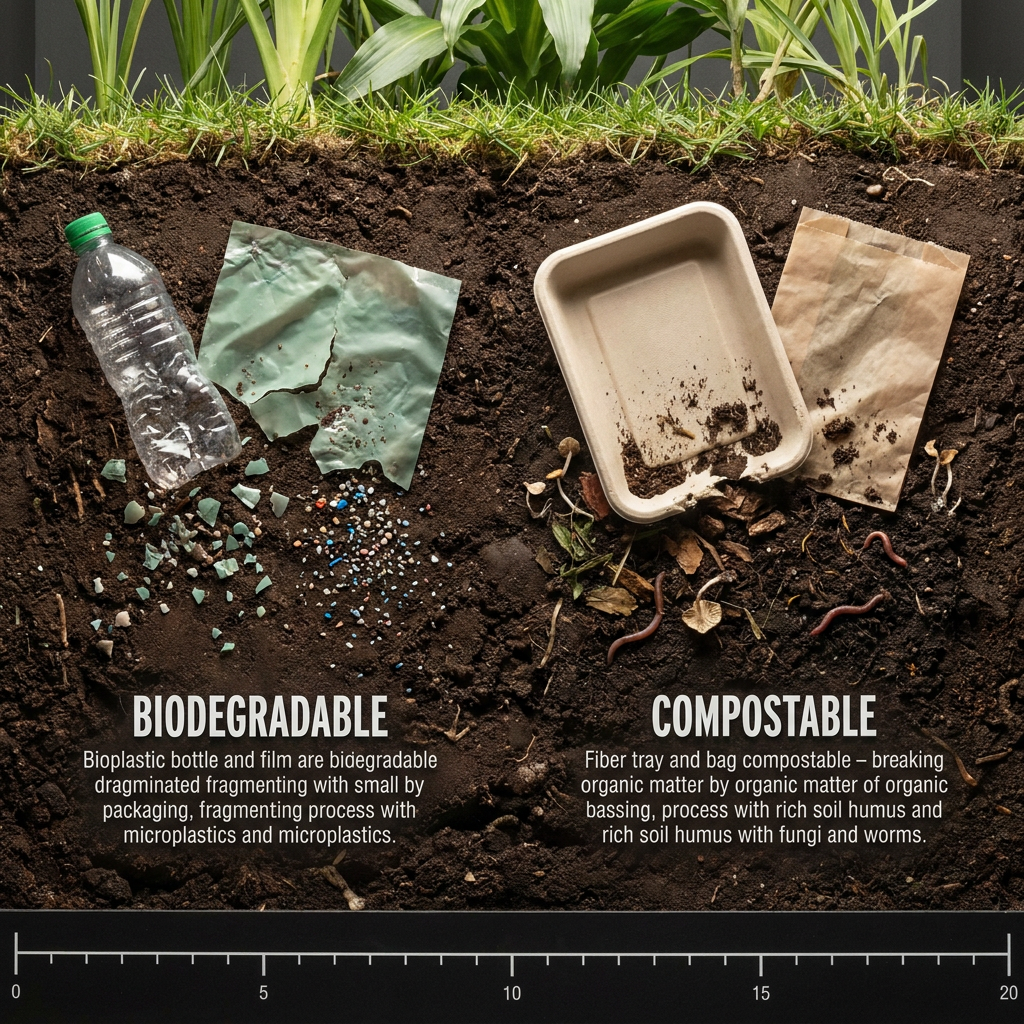
In the world of sustainable business, terms like “biodegradable” and “compostable” are often used interchangeably, but they have very different meanings and implications for the environment. Understanding these nuances is essential for any brand making green claims.
\n\n
Biodegradable packaging refers to materials that can be broken down by microorganisms (like bacteria and fungi) into water, CO2, and biomass over time. While almost everything is technically biodegradable over hundreds of years, the industry standard implies a much faster timeline.
\n\n
Compostable packaging, on the other hand, is a subset of biodegradable. It must break down into nutrient-rich organic matter (compost) within a specific timeframe and leave no toxic residue. Crucially, most compostable plastics require “industrial composting” facilities to break down, as they won’t decompose in a backyard compost pile.
\n\n
Differentiating the Two:
\n
- \n
- Timeframe: Compostable materials have a strict window (often 90-180 days); biodegradable has no set limit.
- End Result: Compostable leaves behind “humus” that enriches soil; biodegradable simply “disappears” (sometimes into micro-fragments).
- Standard Certifications: Look for EN 13432 or ASTM D6400 for compostability.
\n
\n
\n
\n\n
Comparison Table: Biodegradable vs. Compostable
\n\n
| Aspect | Biodegradable | Compostable |
|---|---|---|
| Microbial Breakdown | Yes | Yes |
| Speed | Variable (Years/Decades) | Fast (Months) |
| Toxicity | May leave micro-residue | Must be Non-Toxic |
| Disposal | Landfill / Recycling | Compost Facility |
\n\n
Conclusion:
\n
Choosing between biodegradable and compostable packaging depends on your product’s lifecycle and your customer’s disposal habits. If your goal is to truly nourish the earth, “certified compostable” is the gold standard, but high-quality biodegradable options still offer a significant improvement over traditional plastics.
\n\n
FAQ Section:
\n
Q: Will compostable bottles melt on the shelf?
\nA: No, these materials are designed to be stable during use and only begin breaking down under specific composting conditions (moisture, heat, microbes).
\n
Q: Can I put compostable plastic in the recycling bin?
\nA: No. Mixing compostable plastics with traditional plastics can contaminate the recycling stream. They must be composted.
\n
Q: Are these materials more expensive?
\nA: Yes, currently the raw materials for compostable packaging (like PLA or PHA) cost more than petroleum-based plastics.