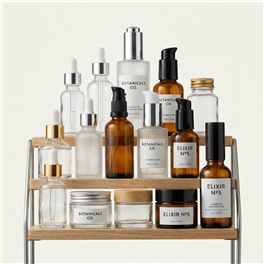
SUMMARY: Choosing the right glass bottle for your skincare product involves more than picking a shape you like. From glass type and surface finish to closure compatibility and neck size, each decision affects product stability, user experience, and production line compatibility. This guide walks through all 7 factors — with comparison tables for each — so you can spec your next glass bottle order with confidence.
7 Factors to Consider When Choosing Cosmetic Glass Bottles
Here’s the framework. We’ll break down each factor in detail below:
- Glass type — soda-lime vs borosilicate
- Surface finish — clear, frosted, coated, or painted
- Bottle capacity — matching volume to product category
- Neck finish and closure — dropper, pump, sprayer, or screw cap
- Color — clear, amber, violet UV, or custom tinted
- Decoration — silk screen, hot stamp, spray coating, or label
- Regulatory compliance — FDA, EU, REACH
1. Glass Type: Soda-Lime vs Borosilicate
| Feature | Soda-Lime Glass | Borosilicate Glass |
|---|---|---|
| Composition | SiO₂ + Na₂O + CaO | SiO₂ + B₂O₃ |
| Thermal Shock Resistance | Moderate | Excellent — lab-grade |
| Chemical Resistance | Good for most cosmetics | Superior — resists acids and alkalis |
| Clarity | High | Slightly lower |
| Cost | Standard (baseline) | 2-3x more expensive |
| Weight | Heavier | Lighter |
| Best For | 95% of cosmetic applications | High-end serums, heat-fill formulas |
Rule of thumb: Soda-lime covers nearly all cosmetic use cases. Go borosilicate only if you’re heat-filling above 60°C or packaging highly acidic formulas (pH below 3.5).
2. Surface Finish: Clear, Frosted, or Coated
| Finish | Visual Effect | Tactile Feel | Durability | Best For | Cost Premium |
|---|---|---|---|---|---|
| Clear | Transparent | Smooth | Standard | Mass-market | — |
| Frosted | Soft, diffused | Velvet matte | Standard | Premium serums | +10-15% |
| Spray Coated | Opaque color | Smooth or soft touch | Moderate | Brand color matching | +15-25% |
| Gradient Spray | Gradual color fade | Smooth | Moderate | Luxury shelf appeal | +20-30% |
3. Bottle Capacity
| Capacity | Best For | Typical Customer |
|---|---|---|
| 5ml – 10ml | Eye serum, essential oil blend | Trial customers |
| 15ml – 30ml | Face serum, facial oil | Standard skincare |
| 30ml – 50ml | Moisturizer, sunscreen | Full-size daily |
| 50ml – 100ml | Body lotion, hair oil | Full-size body care |
| 100ml – 200ml | Shampoo, conditioner | Salon supply |
4. Neck Finish and Closure Compatibility
| Neck Size | Common Closures | Typical Bottle Size |
|---|---|---|
| 13/415 | Dropper cap, sprayer | 5ml – 15ml |
| 18/415 | Dropper, pump, disc cap | 15ml – 50ml |
| 20/410 | Lotion pump | 30ml – 100ml |
| 24/410 | Lotion pump, flip-top | 50ml – 200ml |
| 28/410 | Large pump, screw cap | 100ml – 500ml |
Critical check: Always order a closure sample with your bottle sample. Even standard neck sizes can have 0.2mm tolerance differences between factories.
5. Glass Color: When to Go Beyond Clear
| Glass Color | Light Protection | Brand Association | Best Product Match |
|---|---|---|---|
| Clear | None | Clean, transparent | Attractive products |
| Amber | UV only (280-400nm) | Natural, apothecary | Natural oils |
| Violet UV | Full UV + visible | Luxury natural, CBD | Essential oils, CBD |
| Blue / Green Tinted | Minimal | Unique branding | Niche brands |
| Custom Tinted | Varies | Full brand control | Signature brand color |
6. Decoration Options
| Method | Durability | Detail Level | Cost | MOQ |
|---|---|---|---|---|
| Silk Screen | Good | Moderate | /bin/bash.05-0.15/unit | 1,000-3,000 |
| Hot Stamping | Excellent | High | /bin/bash.10-0.30/unit | 2,000-5,000 |
| Spray Coating + Print | Good | High | /bin/bash.15-0.40/unit | 3,000-5,000 |
| Label (Adhesive) | Good | Very High | /bin/bash.03-0.10/unit | 500+ |
7. Regulatory Compliance
| Regulation | Covers | Required For | Key Requirement |
|---|---|---|---|
| FDA 21 CFR | Food-contact glass | US market | Lead and cadmium limits |
| EU 1935/2004 | Food contact materials | EU market | Migration limit |
| REACH | Chemical substance safety | EU market | SVHC declaration |
| Prop 65 | Carcinogen warnings | California | Lead content disclosure |
All EcoFusion Group glass bottles meet FDA and EU standards.
FAQ
Q: What’s the difference between Type I, II, and III glass?
A: Type I is borosilicate (highest chemical resistance), Type II is treated soda-lime, Type III is standard soda-lime. For 95% of cosmetic applications, Type III soda-lime is sufficient.
Q: Can I mix different bottle sizes in one order?
A: Yes, most suppliers allow mixed sizes in one order as long as each size meets minimum quantity.
Q: How long does custom glass bottle production take?
A: Stock bottles ship in 3-7 days. Custom molds take 15-30 days, plus 15-20 days for production. Custom decoration adds 5-10 days.
Q: What’s the minimum order quantity for glass bottles?
A: Stock: 500-1,000 pcs per size. Custom decoration: 1,000-3,000 pcs. Custom molds: 10,000-50,000 pcs.
Q: Do frosted glass bottles fingerprint easily?
A: High-quality frosting minimizes fingerprints. Cosmetic oils can leave marks — include a cleaning cloth if selling frosted bottles directly to consumers.
Explore our cosmetic glass bottle collection at EcoFusion Group — clear, frosted, amber, UV, and custom-tinted glass bottles from 5ml to 200ml.