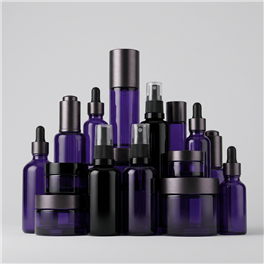
Why Light Destroys Cosmetic Ingredients — and How UV Glass Stops It
Light is the silent enemy of natural cosmetics. Unlike oxygen or heat, its damage isn’t obvious until the product changes color, loses scent, or stops working. Three types of light damage cosmetic formulas:
Light Type
Wavelength
Damage to Cosmetics
UV-A
315-400 nm
Breaks chemical bonds in vitamins and antioxidants
UV-B
280-315 nm
Accelerates oxidation, color fading
Visible Blue Light
400-500 nm
Degrades essential oil terpenes and natural pigments
Standard clear glass blocks none of these. Amber glass blocks UV-A and UV-B but lets visible light through. Violet UV glass — the premium option — blocks the entire damaging spectrum (280-500 nm) while allowing infrared to pass, which has a subtle preservative effect on certain plant-based ingredients.
Violet UV Glass vs Amber Glass: Which One Do You Need
Feature
Violet UV Glass
Amber Glass
Clear Glass
Light Blocking Range
280-500 nm (UV + visible)
280-400 nm (UV only)
None
Color
Deep violet to near-black
Brown-amber
Transparent
Product Visibility
Opaque — buyer sees bottle color
Semi-transparent — buyer sees product color
Full visibility
Shelf Life Extension
2-4x vs clear glass
1.5-2x vs clear glass
Baseline
Best For
CBD, essential oils, natural serums
Mass-market oils, amber aesthetic brands
Products with synthetic preservatives
Cost Premium vs Clear
+30-50%
+10-20%
—
Bottom line: If your formula contains essential oils, CBD, or any plant-derived active without strong synthetic preservatives, violet UV glass is worth every cent.
What Ingredients Require UV Glass Packaging
Ingredient Type
Light Sensitivity
Recommended Glass
Consequence of No UV Protection
Essential Oils (lavender, tea tree, citrus)
Very High
Violet UV glass
Oxidation → skin irritation, loss of therapeutic properties
CBD / Hemp Extract
Very High
Violet UV glass
THC conversion, potency loss, color darkening
Vitamin C (L-ascorbic acid)
High
Violet or amber
Browning, loss of antioxidant activity
Retinol / Retinoids
High
Violet UV glass
Degradation, increased irritation risk
CoQ10 / Ubiquinone
High
Amber or violet
Crystallization, efficacy loss
Plant Oils (argan, rosehip, jojoba)
Moderate to high
Amber minimum; violet preferred
Rancidity, off-odor
Synthetic Actives with Preservatives
Low
Amber / clear
Minimal impact
Matching UV Glass Bottle Sizes to Product Categories
Bottle Size
Product Application
Common Closure
5ml – 10ml
CBD serum sample, essential oil travel size
Dropper cap
15ml – 30ml
Full-size face serum, facial oil
Dropper or pump
30ml – 50ml
CBD tincture, body oil
Dropper with graduated pipette
50ml – 100ml
Massage oil, hair serum
Pump or disc cap
100ml+
Bulk essential oil, salon-use products
Screw cap
How to Market UV Glass Packaging to Your End Customers
UV glass isn’t just functional — it’s a marketing asset:
“Dark glass = premium” — Consumers associate violet glass with high-end natural products, similar to how amber bottles signal “artisan” in the beer industry
Preservative-free positioning — UV glass lets you reduce or eliminate synthetic preservatives, aligning with clean beauty trends
Shelf presence — Violet glass stands out on store shelves among clear and amber competitors
Reusability narrative — UV glass bottles are highly reusable; many end customers repurpose them as home apothecary containers
FAQ
Q: Is violet UV glass the same as black glass?
A: Violet UV glass appears nearly black in thick cross-sections but deep violet in thinner walls. The terms “violet UV glass” and “black UV glass” refer to the same material category — soda-lime glass doped with metal oxides (typically cobalt and iron) to achieve light-blocking properties.
Q: Can UV glass bottles be screen printed or labeled?
A: Yes. UV glass surfaces accept silk screening, hot stamping, and adhesive labels. Due to the dark surface, use light-colored inks (white, gold, silver) for maximum contrast.
Q: Does UV glass work for clear gel products?
A: If your product needs to show its color or texture (e.g., shimmer gel, colored serum), UV glass is not ideal — the dark bottle hides the product. Consider amber glass or a frosted outer carton as alternatives.
Q: What MOQ for custom UV glass bottles with branding?
A: Custom UV glass bottles typically start at 1,000-3,000 pcs for silk screening and 5,000+ for custom molds. Stock sizes (5ml-100ml) with standard closures have lower MOQs.
Q: Is violet UV glass recyclable?
A: Yes. UV glass is standard soda-lime glass and fully recyclable through municipal glass recycling streams. The metal oxide colorants do not affect recyclability.
Explore our UV glass packaging collection at EcoFusion Group — violet UV glass dropper bottles, pump bottles, and jars in sizes from 5ml to 100ml.